A yantra is a tool.
The word means exactly that.
In the western view, a yantra is a geometric map — a precise form that organizes attention and opens access to deeper states of consciousness.
In the tradition it is something more: the yantra is the vehicle, the mantra is the fuel, and together they create a portal — an opening into a world that was already there, waiting for the right key.
Both descriptions are true. Where you begin depends on where you are standing.
These ten yantras are offered freely as objects of beauty, contemplation, and study. Each one corresponds to one of the ten Mahavidyas — the great wisdom goddesses of the Tantric path. Each one carries a geometry that has been used for millennia to focus awareness toward a particular quality of consciousness.
You do not need initiation to work with a yantra as a visible form. Place it where you will see it. Let your eye rest on it without analysis. Notice what arises.
Initiated puja practice — the full use of yantra with mantra, ritual, and lineage transmission — is a different entry. That instruction is available through personal work with AFT.
Your chart may indicate if this kind of practice is effective for you.
Each yantra is an 8.5 × 11″ PDF, suitable for printing.
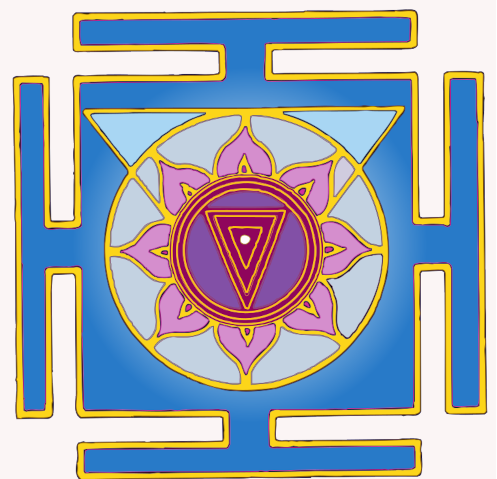
Kali is the face of Saturn — the composting intelligence that dissolves what no longer serves. Her yantra is a downward-pointing triangle nested in lotus and light, blue as the sky before dawn. She governs time, ego, and the deep clearing that makes space for what is real. Working with Kali is not destruction but release: the willingness to let go of what has been outgrown so that what remains can grow. Her practice is offering. Her gift is freedom from what we cling to.
Download PDF ↓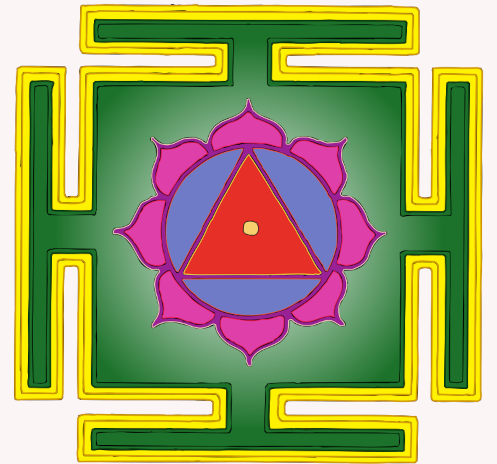
Tara carries the wisdom that travels with the soul across every threshold. Her yantra is green — the color of Jupiter’s generosity — with a single upward triangle rising from a lotus circle. She is the guide through transitions, the voice that stays oriented when everything else is shifting. In Tibetan tradition she is the savioress; in Jyotish she is Jupiter, the planet of transmission and accumulated understanding. Her mantra is Om — the most universal sound, available to all, requiring nothing but open listening.
Download PDF ↓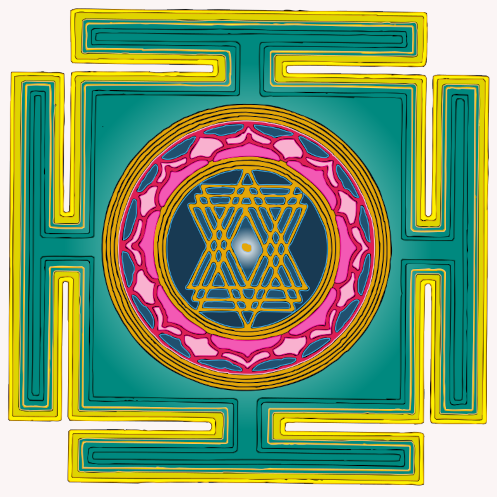
Tripura Sundari — the beautiful one of the three worlds — is the recognition of what was always already present. Her Mahavidya yantra is a wheel of nine interlocking triangles resolved into a luminous center, one of the most geometrically complex arrangements in the Tantric tradition and the most universally revered in the Shakta path. She corresponds to Mercury and Venus — the planets of speech, beauty, and intelligence — and her teaching is that what you are looking for is already looking. Her practice is self-inquiry. Her bija is Hrim.
Download PDF ↓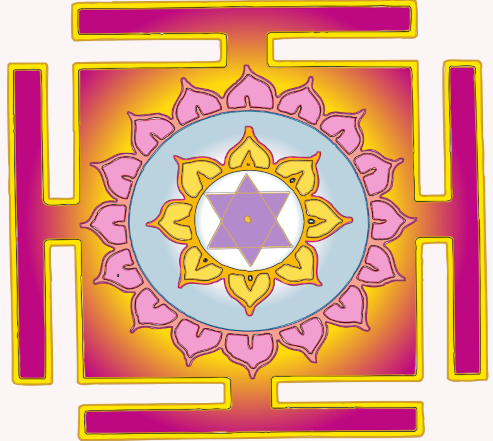
Bhuvaneswari is the dawn before the world takes shape — the open field of possibility from which all things emerge. Her yantra radiates outward in warm golds and magentas, a Star of David held within rings of petals and light. She is the Moon: receptive, spacious, the mother field that holds without grasping. Her teaching is the art of open attention — witnessing without commentary, present to what is before choosing what it means. Her gift is the capacity to be present before interpretation begins.
Download PDF ↓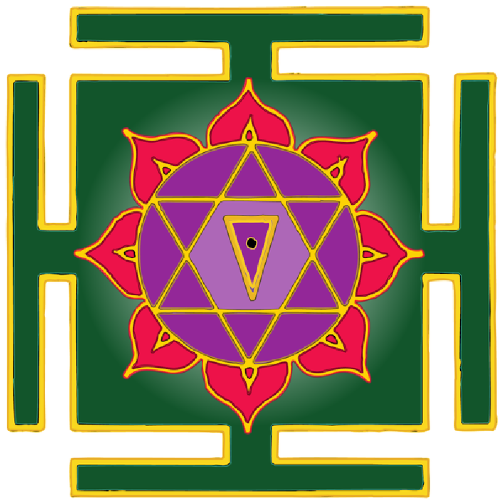
Bhairavi is the fire at the base — the kundalini intelligence that purifies the vessel before anything else can arrive. Her yantra is grounded in green, with red and purple petals and an inverted triangle pointing downward into the earth. She is Mars: the heat of practice, the discipline that makes the body capable of holding what wants to move through it. Without her preparation, the door opens but the practitioner cannot stand in it. Her practice is the work itself — consistent showing up, tapas, the daily fire. Her gift is capacity.
Download PDF ↓
Chinnamasta is the offering intelligence — the recognition that what appears as sacrifice is actually the mechanism of transformation. Her yantra is a black field with gold geometry, one of the oldest auspicious patterns known: the continuous turning of life force. She corresponds to Rahu — the force that moves beyond the familiar mind, severing the assumption that we know what we need. Her teaching: the sixth house is not the house of enemies but the house of offerings. What you give away is what opens the channel.
Download PDF ↓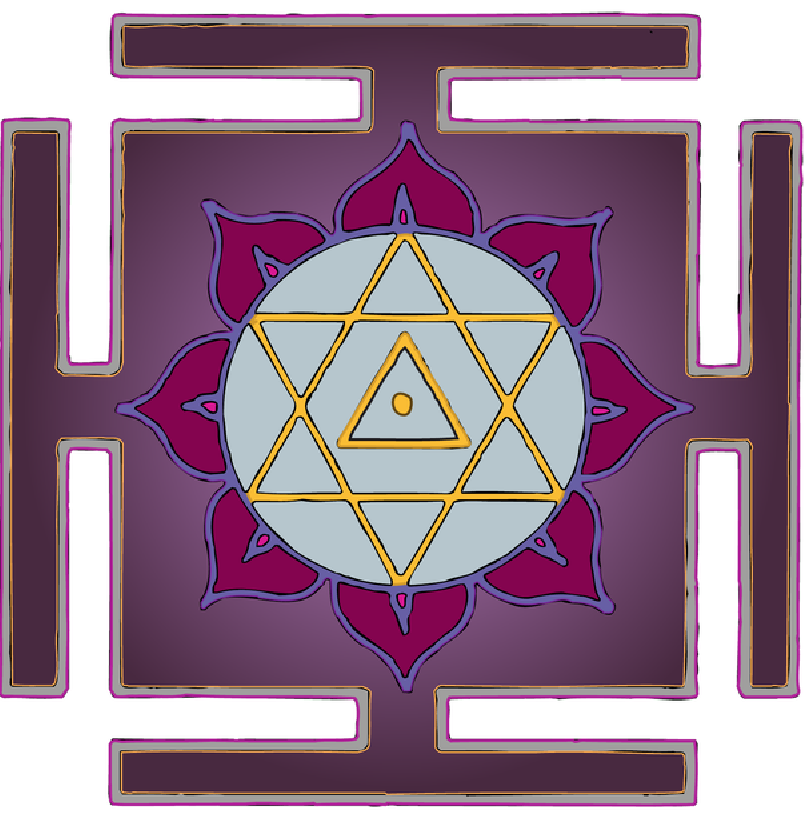
Dhumavati is the smoke that remains after the fire has passed. Her yantra is deep purple and maroon, a Star of David turning inward, quiet and absorptive. She corresponds to Ketu — the planet of dissolution into the formless. She governs loss, grief, the recognition that the phenomenal world and its rewards are, in themselves, incomplete. This is not despair — it is accurate perception. Her teaching is the most liberating: what you were holding was never yours to keep. Her practice is stillness, fasting, and the enormous relief of putting something down.
Download PDF ↓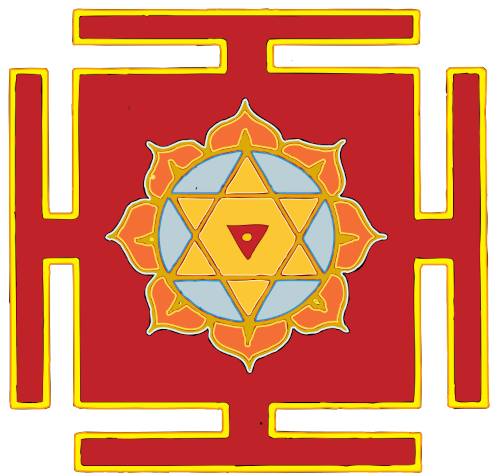
Bagalamukhi is the paralyzing force — the capacity to stop an obstacle in its tracks through stillness and precise attention. Her yantra is bold red and gold, a Star of David surrounded by strong lotus petals: the colors of assertion, clarity, stopping power. She corresponds to Mars and Mercury together — will and intelligence combined, identifying exactly what needs to halt. Her practice is mauna, the vow of silence: the discovery that most of the momentum we give to what harms us is carried in our own speech. When the tongue stops, the obstacle loses its fuel.
Download PDF ↓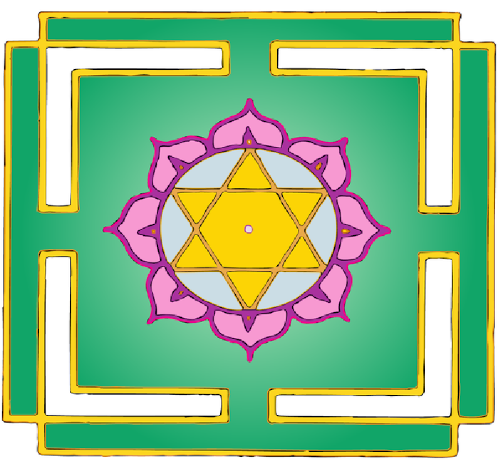
Matangi is the outcast goddess — the one who dwells at the margins and speaks with the authority of those who have seen what others prefer not to look at. Her yantra is green and gold, a clean hexagram of two interlocking triangles in a lotus circle. She corresponds to the Sun: the planet of speech, recognition, and authority. Her gift is the word that carries the full weight of what has actually been seen — not the diplomatic version, not the polished one, but the true one. Artists, teachers, and all who work with the power of naming are in Matangi’s domain.
Download PDF ↓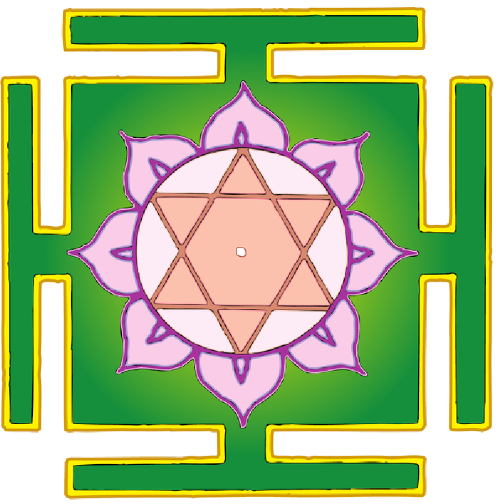
Kamala is Lakshmi in her Tantric form — the recognition that abundance is not separate from practice but is its natural expression. Her yantra is soft green and gold, a Star of David in gentle lotus petals, luminous rather than intense. She corresponds to Venus: the planet of beauty, pleasure, and the good life rightly understood. Her teaching is gratitude — not as sentiment but as accurate perception. What arrives when we stop fighting with what is present? Her practice is generosity and the simple discipline of noticing what is already here.
Download PDF ↓All ten yantras in a single document:
All Ten Mahavidya Yantras — Combined PDF ↓For instruction in initiated puja practice with mantra, ritual, and lineage transmission:
Work with AFT →